 Cardano SPO
29 October 2026 · Delegating
How to check a stake pool before you delegate
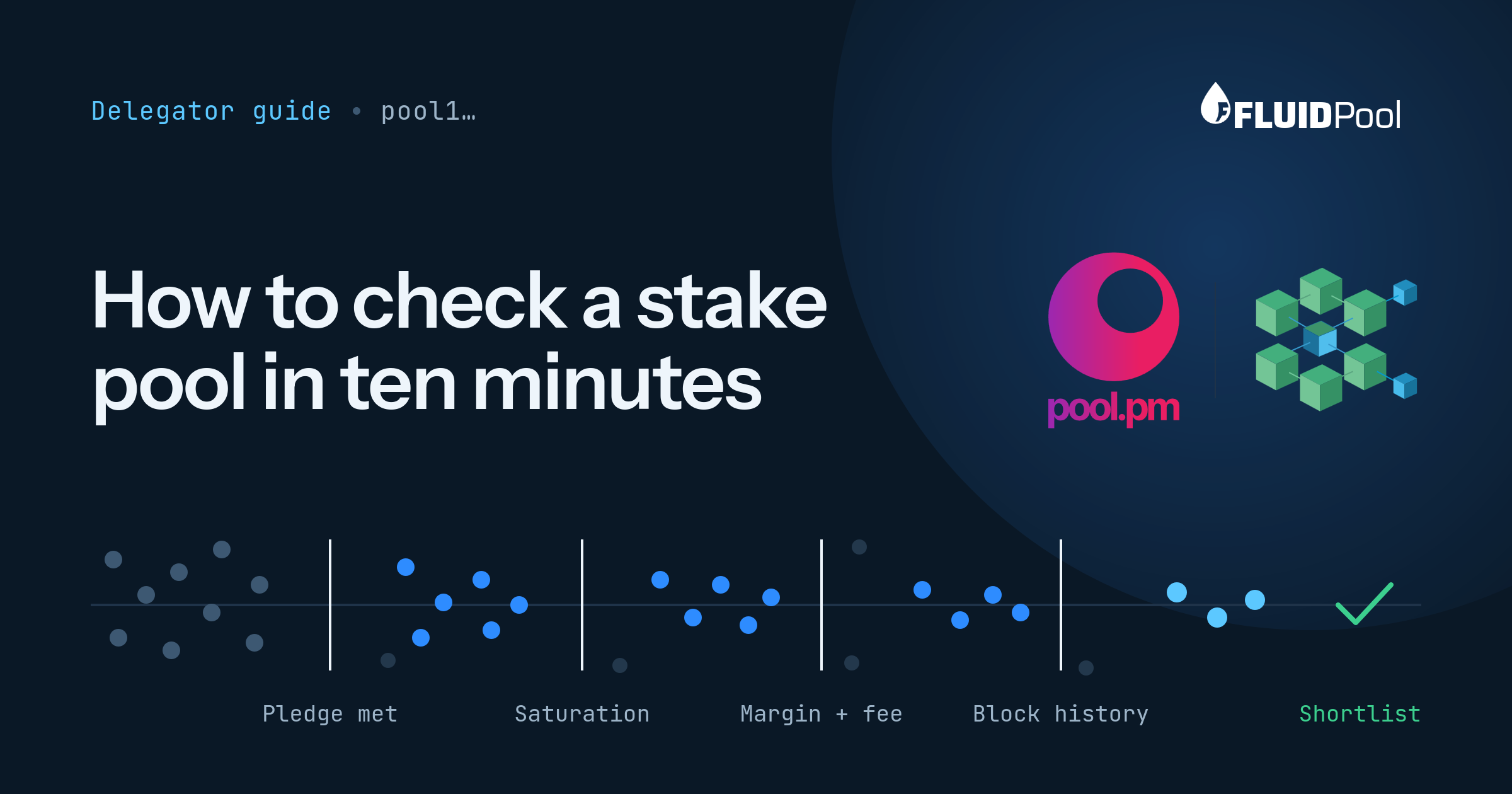
Picking a stake pool is not like picking a savings account. Nobody quotes you a rate. What you get back depends on a handful of numbers the operator sets, a couple the network sets, and how well the pool actually runs. All of them are public. Ten minutes with the right tools tells you most of what you need to know.
Be clear about what these checks are for. Staking pays roughly two percent a year right now, and every healthy, unsaturated pool lands close to that, so the numbers rarely separate a good pool from a great one. What they do is catch the pools that will quietly cost you: an unmet pledge, a pool past saturation, an operator who misses blocks. Treat this as a filter, not the decision. The decision comes after, and we wrote about it in Your stake is a vote, not a yield.
Where to look
pool.pm is the friendly view. Search by ticker or paste in the pool's ID (the long one starting pool1) and you get its parameters, stake, delegators and recent blocks on one page. Tickers are not unique, so if a search turns up more than one pool, check the ID matches the one the operator publishes.
Koios is the raw view. It is a free, community-run API for Cardano data. The pool_info endpoint returns a pool's current settings and stake, and pool_history returns its record epoch by epoch, including blocks minted and return on stake. Amounts come back in lovelace, a millionth of an ADA, so mind the zeros.
AdaStat's pool list is the way to compare pools rather than look one up. Open the advanced filter and you can narrow the whole network down by live stake, declared pledge, margin, fixed cost and lifetime blocks, hide oversaturated pools and pools with a broken pledge, then sort what is left by lifetime return on stake. It is the quickest way to turn a few thousand pools into a shortlist worth checking properly.
Use AdaStat to build a shortlist, pool.pm to get a feel for each pool, and Koios when you want to check the history properly.
Margin
The margin is the percentage of the pool's rewards the operator keeps, after the fixed fee has come off. A higher margin means a smaller share of each epoch's rewards reaches delegators.
It is worth reading alongside everything else rather than on its own. A pool with a low margin that rarely makes blocks can deliver less than one with a modest margin that runs like clockwork. Also check whether the margin has changed recently. Operators can update it, and a pool that keeps creeping it up is telling you something.
Fixed fee
The fixed fee comes out of the pool's rewards every epoch before the margin is applied. It is a flat amount, so its effect on your return depends on how much stake the pool has.
On a large pool the fixed fee is spread thinly across a lot of stake and barely registers. On a small pool the same fee takes a much bigger bite out of each epoch's rewards. That is not a reason to avoid small pools, many of which are run very well, but it is a reason to look at the fee and the stake together and not just glance at the margin.
Saturation
Every pool has a saturation point. Past it, the rewards stop growing with the stake, so the same rewards get shared among more delegators and everyone's return falls. pool.pm shows saturation as a percentage, and Koios reports it as live_saturation.
A pool sitting near or over saturation is worth a second look, whatever else it has going for it. At the other end, a pool with very little stake will make blocks less often, so its returns arrive in lumps: some epochs nothing, some epochs a lot. Over a long enough period that averages out, but you need to be comfortable with the wait.
Pledge
Pledge is the operator's own ADA committed to the pool. It matters in two ways.
First, it is a signal. An operator with real money in the pool has a reason to keep it running.
Second, and more practically, the pledge has to be honoured. If the stake the owners actually hold falls below the declared pledge, the pool earns no rewards for that epoch. Not reduced rewards, none. Koios shows both pledge and live_pledge, and the second should be at least the first. This is one of the quickest checks you can do and one of the most useful.
Block history
This is where reliability shows up. Block production on Cardano is probabilistic, so any pool will have lucky and unlucky epochs. One quiet epoch means very little.
What you are looking for is the pattern over many epochs. Pull pool_history from Koios and look at blocks minted and epoch_ros, the return on stake for each epoch. A pool that tracks roughly what its stake should produce is doing its job. A pool that sits consistently below, epoch after epoch, may have operational problems such as missed slots or poorly connected relays.
One trap: the most recent couple of epochs often show a return of zero because rewards for them have not been calculated yet. In Koios those rows have empty reward fields. Ignore them rather than reading them as a bad run.
A few other things
Check the pool is not retiring. pool.pm will flag it, and a retiring pool stops earning once the retirement epoch arrives.
Look at the pool's metadata and website. A real operator usually tells you who they are, where the pool runs and how to reach them. That is not proof of competence, but its absence is a mild warning.
Once the numbers check out
If a pool passes all of the above, its return will look much like every other pool that does. That is the point where the choice stops being arithmetic. Your stake is weight: it decides which operators stay viable, and through governance, whose voice carries. So the better question is what the operator does with it. Do they build tools other people use, teach, fund or deliver Catalyst work, vote thoughtfully as a dRep? Your stake is a vote, not a yield makes that case in full.
What delegating does and does not do
Delegating does not move your ADA or lock it. It stays in your wallet, you can spend it at any time, and you can switch pools whenever you like. A change takes a few epochs to show up in rewards, so it pays to check properly once rather than hop about.
Sign the delegation from a hardware wallet if you have one. Keystone is our pick, with Trezor a solid alternative.
You can run every check above on FLUID too. Our live numbers are on the FLUID dashboard, and the numbers on pool.pm and Koios will tell you the same story, or they should. Then judge us on the second question, not just the first.