 Cardano SPO
23 September 2026 · News
Your stake is a vote, not a yield
There is a comfortable story people tell about staking ADA: you delegate, you earn a yield, the yield is your reward. It is time to be honest about the size of that reward, because once you see it clearly, the whole logic of how you delegate changes.
What ADA staking actually pays right now
Delegation rewards come out of the Cardano reserve, and the reserve is a finite pot that shrinks every epoch. In the early years that pot was large and the yields looked healthy, around 4.5 to 5 percent. It has been falling ever since, for the simple reason that there is less reserve left to pay out.
As of epoch 657, the live figures are:
- Reserve remaining: ~6.1 billion ADA (down from ~14bn at launch)
- Total active stake: ~21.4 billion ADA
- Monetary expansion (ρ): 0.3% of the reserve per epoch, treasury tax (τ): 20%
Run those through the reward equation and, more usefully, look at what large well-run pools actually paid their delegators over the last few settled epochs, and you land in the same place: a realized return of roughly 1.9 percent a year. Six of the largest pools on the network came in between 1.6% and 2.25% over settled epochs. That is the real number. Not 5%, not the 3% you may remember. About two percent, and still drifting down.
Sources: api.koios.rest, epoch 657. Realized figures are per-pool epoch_ros averaged over settled epochs; network parameters from epoch_params and totals.
The small-pool tax: minPoolCost
It gets sharper for smaller pools, because every pool pays a fixed operating fee, the minPoolCost, currently 170 ADA per epoch it produces a block. On a large pool that fee is a rounding error spread across millions of staked ADA. On a small pool it is a genuine tax.
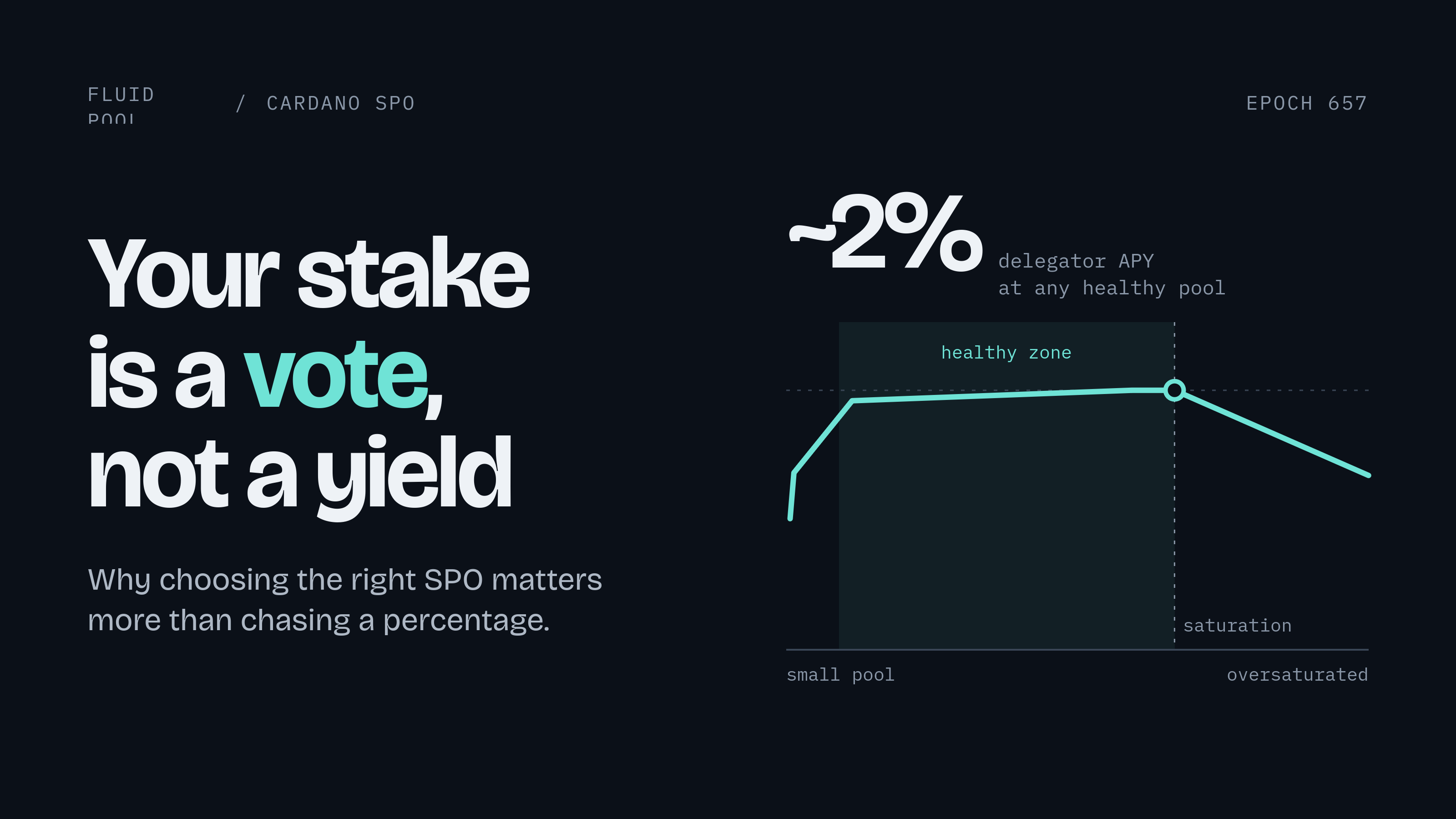
Here is the picture across pool sizes, at today's ~2% gross rate, before any operator margin:
| Pool stake (ADA) | % of saturation | Delegator APY |
|---|---|---|
| 500,000 | 1% | ~1.0% |
| 1,500,000 | 2% | ~1.35% |
| 12,500,000 | 17% | ~1.9% |
| 65,500,000 | 89% | ~1.98% |
| 73,500,000 (fully saturated) | 100% | ~1.98% |
| 110,000,000 (oversaturated, 1.5x) | 150% | ~1.33% |
Two forces pull at the ends of that table. At the bottom, the fixed fee eats into a small pool's rewards, worst of all below about 1 million ADA. At the top, once a pool passes saturation (~73.5M ADA at present), its rewards are capped. An oversaturated pool earns no more in total than a full one, but that same reward is now divided among more stake, so everyone's return falls. The flat, healthy zone sits from roughly 10 million ADA up to saturation, and even there it is only about two percent.
The uncomfortable conclusion
Two percent, minus a little for the operator's margin, is not an investment return. It will not build anyone's wealth. If you hold ADA, the meaningful upside is not the yield, it is whether the network itself becomes more valuable over time. The staking reward is a small top-up on that bet, not the bet itself.
That single fact should change how you delegate.
If the yield is small, what are you actually choosing?
If every healthy, non-saturated pool pays you roughly the same two percent, then the percentage is not a real decision. You are not choosing a return. You are choosing who to hand your stake weight to, and stake weight is influence: it decides which operators stay viable, which get to make blocks, and increasingly, through governance, whose voice carries.
So the honest question is not "which pool pays most?" It is "which operator does something useful with the influence I give them?"
Some operators run a server and nothing else. Others put their position to work: funding and delivering Catalyst proposals, building open tooling other developers rely on, teaching new operators, voting thoughtfully as delegated representatives, showing up for the network when it needs maintenance rather than just rewards. Those contributions are what actually grows the value your ADA is riding on. When you back a builder, your near-worthless two percent is buying something real, a stronger ecosystem, which is the only thing that makes the holding worthwhile in the first place.
Delegating to a pure yield-maximiser with no contribution is, in effect, spending your one lever on nothing.
Stake accordingly
The maths is settled and a little bleak: staking yield alone will not make you money. That is precisely why the choice matters. Your delegation is a recurring, compounding vote for the kind of Cardano you want to exist in ten years. Cast it for the people building that Cardano.
Pick an operator who is not saturated, so your rewards are not diluted, and who visibly gives back to the ecosystem. The two percent will look after itself. What you are really deciding is whether the network is worth holding at all, and that is a decision you make one delegation at a time.
A note on the parameters. Both levers here are under active governance review right now. There is a live proposal to cut the minPoolCost fee from 170 to 75 ADA, and a draft action to raise k from 500 to 1,000. Either would shift the numbers above, and as a dRep I am following both.
This is analysis and opinion, not financial advice. Staking yields quoted are live network figures as of epoch 657 and will change as the reserve depletes. Nothing here is a recommendation to buy or hold any asset. Do your own research.