 Cardano SPO
9 October 2026 · RealFi
RealFi on Cardano mainnet: what the latest community call covered
RealFi is live on Cardano mainnet, and the team ran a public community call to walk through what is now available. This is a recap of the main points. As a RealFi accelerator pool, FLUID has been following the project closely, so it is worth setting out plainly what the protocol does and, just as importantly, where the risks sit.
Nothing here is financial advice. Yield products carry real risk, including the risk of liquidation and of loss. Do your own research and never commit capital you cannot afford to lose.
What RealFi is
RealFi is a real-world-asset (RWA) yield protocol. Rather than chasing on-chain farming rewards, it puts capital into a portfolio of real assets and passes the return through to token holders. On the call the team described the portfolio as a set of "sleeves":
- Sleeve A - liquid: mainly tokenised money market funds.
- Sleeve B - semi-liquid: mainly CLO ETFs (collateralised loan obligation funds, effectively baskets of private credit).
- Direct lending: less liquid, but a higher return.
The blended yield at the time of the call was roughly 8.5%, but that figure is not fixed. It moves with the asset mix (more illiquid private credit means higher yield) and with the staking ratio (a lower staking ratio means a higher yield for each staker). Treat any headline rate as a snapshot, not a promise.
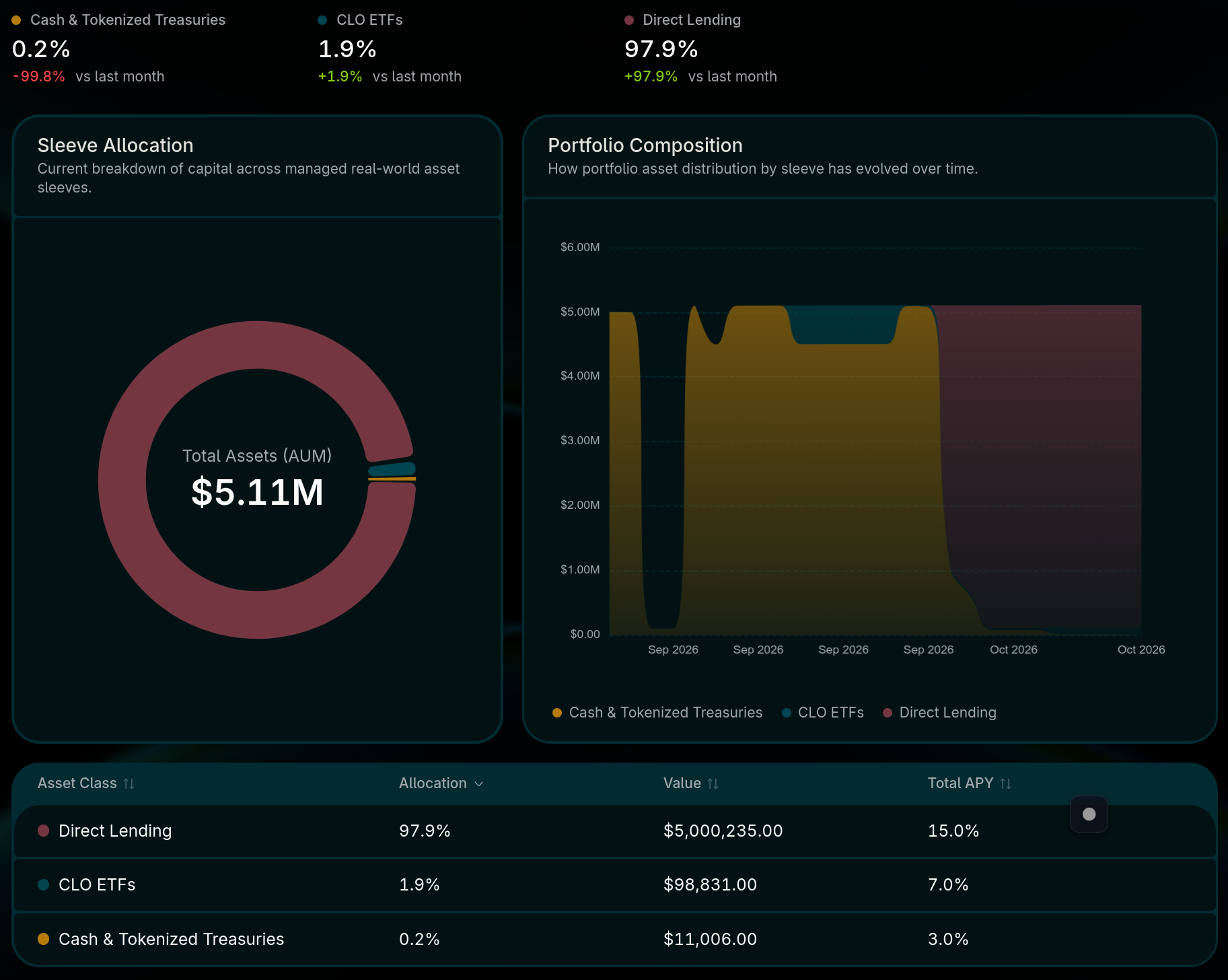
A snapshot from the transparency portal's Sleeve Allocation view. Here the portfolio sat at $5.11M AUM, heavily weighted to direct lending (the higher-yield, less-liquid sleeve), with smaller slices in CLO ETFs and cash. The mix shifts over time, and the blended yield moves with it.
The tokens
- USDRF - the protocol's dollar-denominated stable token.
- sUSDRF - the staked, yield-bearing version. Stake USDRF into sUSDRF and it earns the portfolio yield.
- USDCX - the dollar stable used to enter and exit positions.
- RFG - the governance token, to be distributed at the Token Generation Event (TGE).
A simple position: take USDCX, swap to USDRF, stake into sUSDRF, and earn the portfolio yield. $1,000 in, roughly $1,085 a year later at 8.5%.
DeFi utility: Liqwid and SundaeSwap
The tokens plug into Cardano DeFi. Through Liqwid Finance, USDRF can be used as collateral and borrowed, and sUSDRF is enabled as collateral in an isolated market. Through SundaeSwap, the tokens can be swapped and liquidity provided.
At launch this created an arbitrage: some users borrowed USDRF on Liqwid, swapped it for USDCX, and supplied that back at a higher rate, pocketing the spread between borrow and supply rates. That is a normal DeFi behaviour and exactly the sort of utility the protocol wants to enable. Rates move with utilisation, so spreads like that do not last.
Looping, and why the risk matters
Because sUSDRF is accepted as collateral, you can amplify a position by "looping":
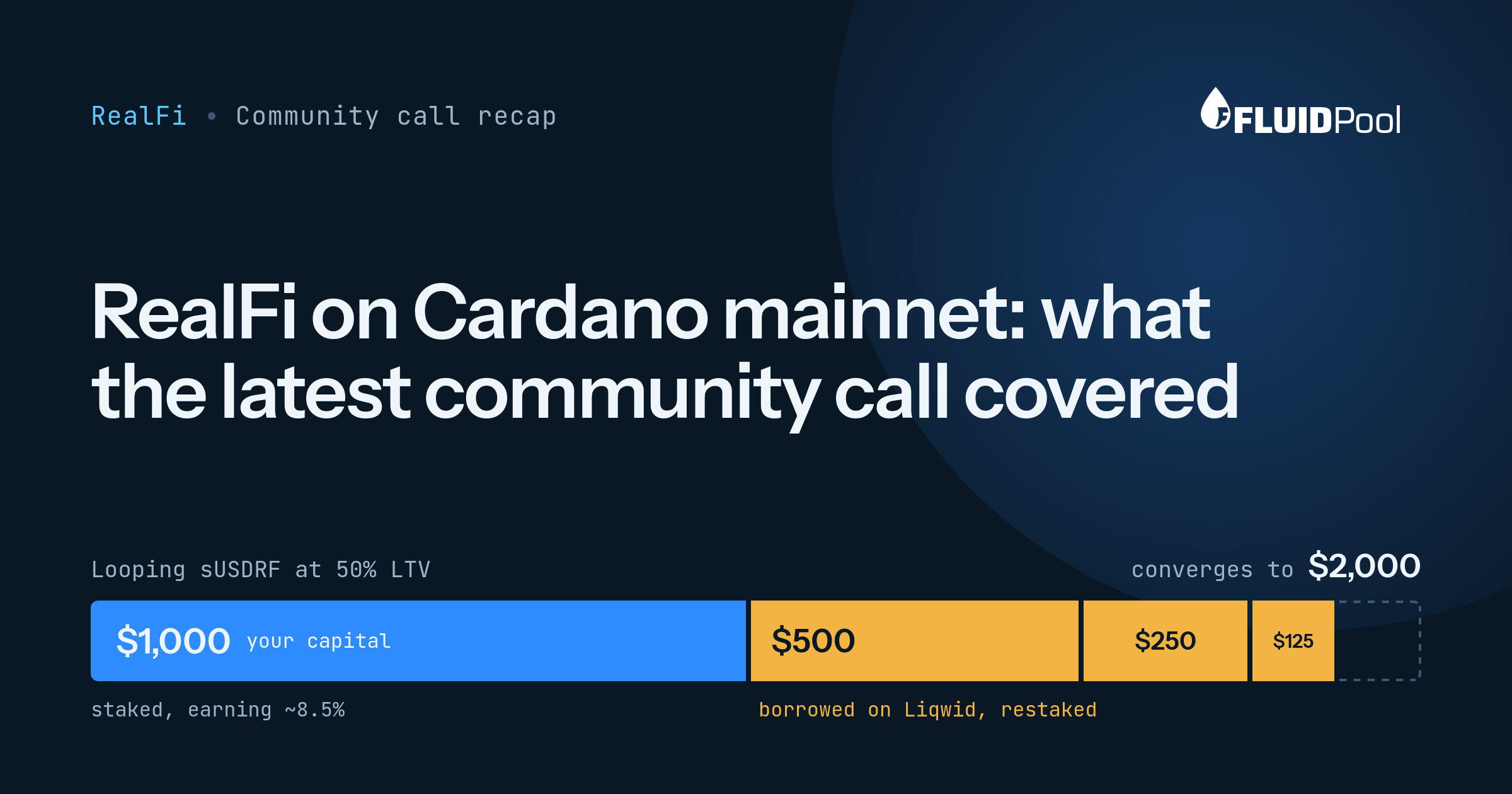
- Stake $1,000 into sUSDRF, earning 8.5%.
- Deposit it as collateral on Liqwid and borrow, say, $500 of USDCX at a 50% loan-to-value (LTV).
- Stake that $500 into sUSDRF as well, and repeat with smaller amounts ($250, $125, and so on).
After three loops - borrowing $500, then $250, then $125 - you hold a roughly $1,875 earning position off $1,000 of your own capital, and at this 50% LTV the stack converges toward $2,000 if you keep going. Because the whole position earns yield while only $1,000 is yours, the effective APY on your base capital rises above the headline 8.5%, provided that yield stays above your borrow cost. The catch is liquidation risk: if the value of your collateral falls below the loan amount, the position is liquidated. The call deliberately used a conservative 50% LTV, because the lower the LTV, the larger the price fall you can survive. If you loop, keep the yield above your borrow rate or the position goes underwater.
The same mechanic works with ADA. If you are long ADA and do not want to sell, you can supply it as collateral on Liqwid, borrow USDRF or USDCX, and route into sUSDRF for yield exposure. That keeps your ADA while diversifying into a yield-bearing position, as long as you watch the ADA price and manage the LTV. Note the team was clear that RealFi's treasury does not hold ADA, because it cannot invest ADA directly without swapping to dollars first.
R-Points and the Voyager Season
Mainnet participation runs through R-Points:
- 1 R-Point per dollar of eligible position per day, multiplied by that position's registry multiplier.
- Tracked at least hourly, finalised daily and rounded down.
- A +50% Genesis Boost is live for the window 1-28 October 2026, applied automatically.
- Referrals earn the referrer a bonus of 10% of your daily points once you pass 5,000 lifetime points.
Points are earned mainly by providing liquidity and supporting stability (for example liquidity to looping markets or to SundaeSwap), not simply by seeking yield. The Voyager Season runs until TGE, with any points cutoff announced at least 72 hours in advance. At TGE, finalised R-Points convert into RFG after an anti-sybil review. The conversion rate is set at that time, is contingent on a mainnet holding requirement, and RFG value is not guaranteed. The team confirmed R-Points and RFG are open globally.
Transparency portal
RealFi runs a transparency portal exposing live protocol metrics: price stability, staking yields, collateralisation ratio, TVL, circulating supply, the composition of the reserves backing the protocol, and how the token is distributed across DEXs, institutions and retail. It is light on history at launch and will gain features as more data accrues.
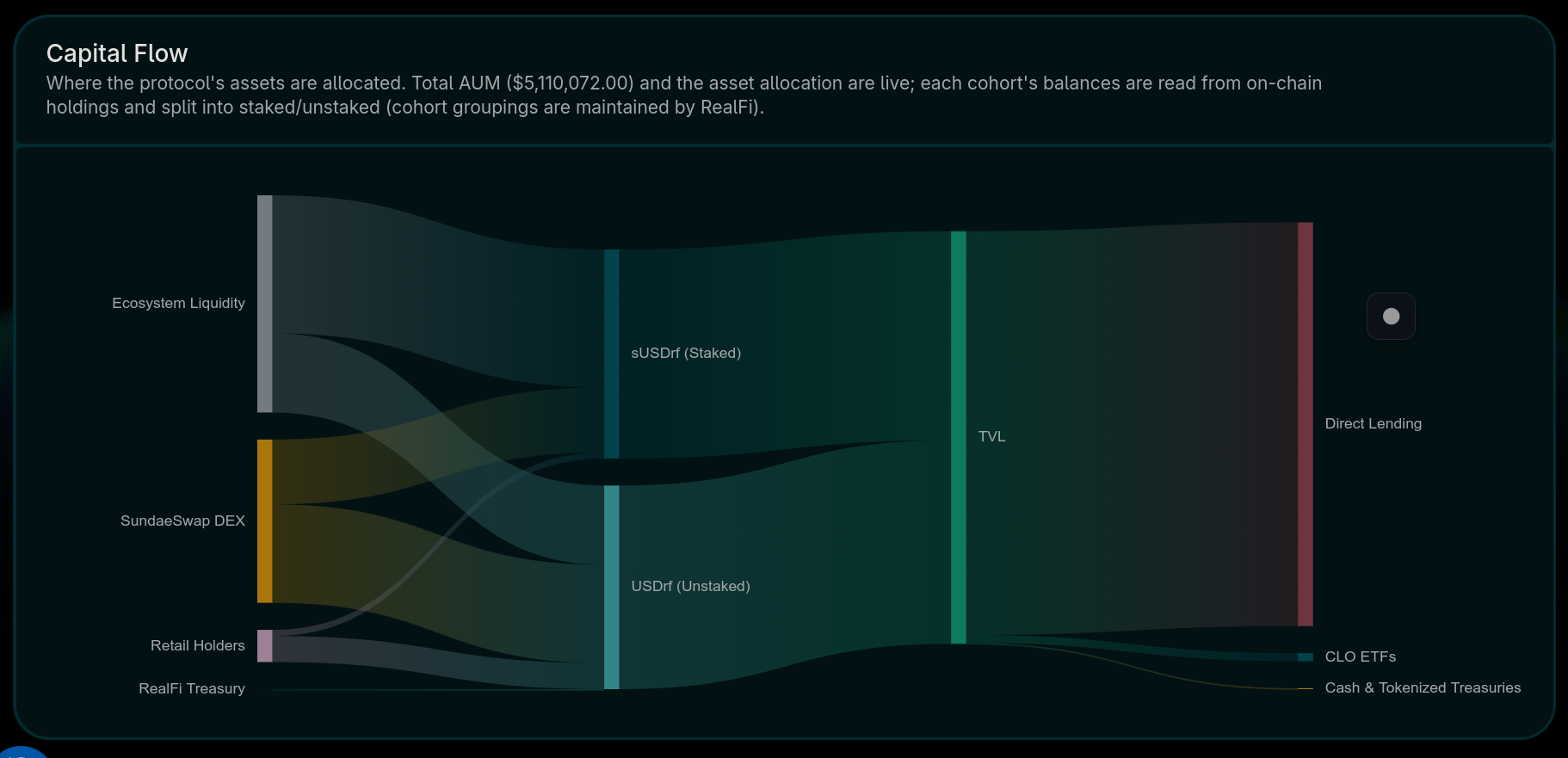
The portal's Capital Flow view: live AUM and how holdings split across staked and unstaked, then flow into the asset sleeves.
What is next
- EVM / Ethereum launch and a cross-chain strategy, with native minting and staking on EVM. The team is working through how TVL moves across chains with DefiLlama.
- TGE targeting Q1, with some dependencies still to fall into place, and tier-one exchange listings lined up for RFG.
- The testnet Pioneer Season is being finalised; the team expects to publish the Pioneer-points-to-RFG conversion rate in the coming weeks.
The framing from the call was that RealFi is a chain-agnostic RWA yield protocol rather than a Cardano-only story. For Cardano holders it is live now; for the wider market, more is coming.
FLUID takes part in RealFi's SPO accelerator. To follow the programme or get involved, start with the RealFi community. For the full picture, see the RealFi documentation.
Recap of a public RealFi community call. Figures and token mechanics reflect what was stated on the call and can change. Not financial advice.