 Cardano SPO
5 October 2026 · News
Is starting or sustaining a Cardano pool the right move for you?
This guide draws on three bodies of work: the Cardano Foundation's paper on economic parameters (2025), Input Output's analysis of the reward system (2026), and the research and proposals of the Cardano Incentives Working Group (2025 to 2026). Each section says what the source found, in its own words where that matters, and the last section turns it into decisions.
The short answer
- A pool is not a route to a wage. Input Output's own conclusion is that "No single-pool operator in the retail market earns a competitive wage for their labour."
- Size decides almost everything, and the protocol does not tell you the sizes that matter. Below about 3 million ADA of stake a pool does not mint reliably. Three quarters of registered pools sit below that line.
- A small pool grows by delegation, not by pledge. All three sources agree on this.
- Delegators mostly choose on visibility and brand, and then stay put. That is the opening for a pool with a clear purpose, and the reason one without it stays small.
- The rules may change. The fixed fee, the number of pools the system aims for, and the pledge rules are all under active proposal.
So the honest case for running a pool is rarely the income. It is what the pool is for: a mission delegators want to back, a seat in governance, infrastructure you already need, or a base for other paid work in the ecosystem.
The sizes that matter
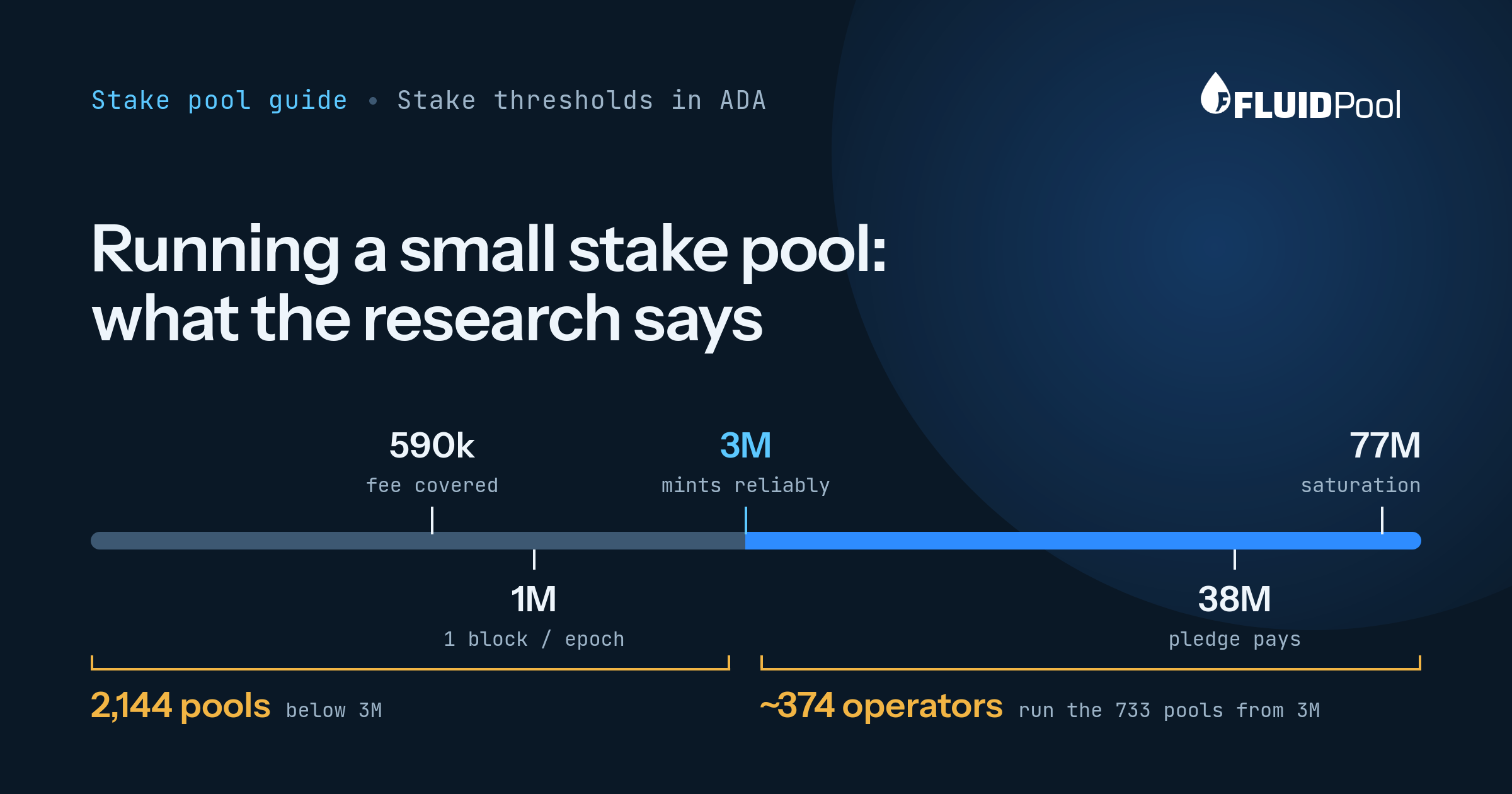
- About 590,000 ADA: Rewards cover a 170 ADA fixed fee. Below this, the operator keeps every reward and delegators earn nothing. Source: Fluid7 calculation from chain data, epoch 657 (September 2026). Input Output puts it at about 0.54 million on April 2026 data.
- About 1 million ADA: One block expected per epoch, on average. Below this, "rewards are noise, not signal". Source: Input Output, pools page.
- About 1.18 million ADA: Rewards cover a 340 ADA fixed fee. Source: Fluid7 calculation, as above. Input Output: about 1.09 million.
- About 3 million ADA: At least one block per epoch with 95% probability. The point where a pool's return becomes something a delegator can judge. Source: Input Output, diagnostic page.
- About 38 million ADA (half of saturation): Pledge starts to raise rewards at any level. Source: Cardano Foundation paper.
- About 77 million ADA: Saturation. Rewards stop growing. Source: Input Output, epoch 623 (April 2026).
Input Output describes the gap between registering a pool and reaching the 3 million line as "an open door that leads to an empty room": anyone may register, and nothing warns them how far the reliable-production line is.
What the Cardano Foundation's paper shows
"Cardano Economic Parameters", Massimo Morini, Cardano Foundation. Last updated March 2025. It analyses how the reward formula treats pools of different size and pledge.
1. Small pools are paid less than their share. A pool with no pledge is rewarded on only about 77% of its stake (the pledge influence setting, a0, is 0.3, and 1 divided by 1.3 is about 77%). In the paper's example, pools at 10% of saturation or less "receive around 7.7% of the available rewards, rather than a full 10%, even if they increase the pledge to 100% of the stake."
2. Pledge does almost nothing for a small pool. For an average pool of 7 million ADA with 1.4 million pledged, the pledge moves rewards from 7.7% to 7.73% of a saturated pool's rewards. For smaller pools the effect is smaller still. Below half of saturation there is always a level of pledge beyond which more pledge slightly reduces rewards.
3. Grow by delegation first. "The incentive to small pools is to increase the stake first by delegation rather than by pledge." The paper adds that pledge still "displays the commitment of pool operators and makes all pools more attractive for delegators", so a modest pledge has a signalling value even where it has no reward value.
4. The design knowingly costs small operators. The paper says the current settings can "have a negative effect on inclusion and decentralization, by reducing the rewards of small pool operators, and of delegators of all pools", and that governance must balance this by acting on the two parameters together.
5. Most pools are very small. Average stake was 7 to 8 million ADA, but "median stake and pledge are very small, due to the presence of very many very small pools."
6. Less is paid out than the headline rate suggests. The reserve is not released at the stated 0.3% an epoch. The actual release "has been between 0.165% and 0.185%", and rewards received 65% to 70% of it, not the 80% the treasury setting implies. Plan on the rewards you see, not the rewards the parameters promise.
What the paper does not say: it sets no "minimum viable" pool size. The 7 million ADA figure is its worked example of an average pool, not a threshold.
Source: https://github.com/cardano-foundation/cardano-economic-parameter-insights/blob/main/whitepaper.md
What Input Output's 2026 analysis shows
"Cardano Reward System", Cardano Business Unit at Input Output, analysis by Nicolas Henin. Edition of 18 June 2026, data to epoch 623 (4 to 9 April 2026). It describes itself as work in progress, and some of its counts differ slightly between pages; where that matters it is noted.
Who is producing blocks
- About three quarters of pools cannot mint reliably. 2,144 of 2,877 registered pools sit below the 3 million ADA line and together hold 2.7% of stake.
- Independent operators are shrinking. "Single-pool operators contracted from 555 pools / 39.1% of productive stake (epoch 300 peak) to 291 / 24.4% (epoch 623)." Another page counts 284.
- Multi-pool operators hold most of the stake. 83 entities run 449 productive pools and hold 76.7% of productive stake. Exchanges and staking services hold a large share at zero pledge.
- Pools churn. 3,497 entries against 3,070 exits from the productive set, about 1.7% turnover an epoch.
What an operator earns
- Income barely rises with size for a single pool. Median revenue is 24,820 ADA a year for a pool below the reliable line, 26,652 for a healthy pool of 3 to 38.5 million, and 31,757 for a large one. Only running several pools changes it: 68,667 ADA for two pools, over a million for eleven or more. In its words, "The MPO model is the only economically rational structure."
- Costs are higher than income at today's price. Infrastructure of $1,320 to $3,240 a year plus 5 to 15 hours a month of skilled work gives a floor of about $7,160 a year. "At $0.25 (April 2026 spot), no single-pool operator covers the cost floor." At $0.50 a single pool roughly breaks even.
- The fixed fee falls hardest on the smallest. It takes about 48% of rewards in a sub-reliable pool and 1.5% near saturation. 64% of pools still declare 340 ADA, three years after the minimum fell to 170.
- Margin is the part that works. 87% of pools set 10% or less, the median is 2%, and it has been stable for years. "Margin competition works; the flat fee is the distortion."
- Pledge does not pay. "Pledging earns less than passive delegation, even at maximum scale." Small operators who do not pledge "are responding correctly to weak incentives, not failing to play."
How delegators behave
- Most do not move. 42% have stayed with the same pool for more than 2.7 years. Switching has fallen 75% since the early Shelley period.
- They are not chasing return. When delegators do switch, half land in a pool with no real difference in return. The report calls them "passive parkers, not yield-shoppers."
- They choose on recognition. Two thirds of retail delegators sit in multi-pool operators' pools that pay less than a well-run single pool. "They are picking on visibility, brand, exchange convenience, or default selection."
- Community works. The report cites one single pool that holds 22,053 delegators "through community visibility".
- Large holders move most. Delegations of a million ADA or more switch far more often than small ones, so a pool built on a few large delegators is less stable than one built on many small ones.
Where rewards are heading
- Return has fallen from 5.3% to 2.0% a year, tracking the reserve.
- Projected: about 1.7% by mid 2027, under 1.5% by late 2027, under 1.0% by late 2029.
- "The declining yield is a selection ratchet against small single-pool operators", and "no pool-level strategy can offset the macro trajectory."
What Input Output suggests
The site is explicit that "Nothing here is yet a deployed mechanism nor a finalised proposal." Parameter recommendations from IO Research are in preparation for the end of 2026. Its direction of travel:
- Fix the fixed fee first. It calls the fee floor "the single largest addressable distortion in the fee layer". Governance can lower it by ordinary vote.
- Redesign the pledge bonus, so the large reward budget that currently goes unused reaches pools that commit to a rule. This needs a hard fork.
- Do not expect a higher k to help on its own. "The 'k-raise helps small pools' framing has no mechanical foundation."
- Longer term, an explicit minimum pool size of about 3 million ADA, with a "Pool Alliance" so small operators can combine to reach it. What happens to the existing small pools is an open question.
Source: https://input-output-hk.github.io/spo-incentives/
What the Incentives Working Group has researched and proposed
The Cardano Incentives Working Group (incentives.solutions) is "an independent collective of SPOs and dReps formed in February 2025". It is volunteer run and unfunded, and its members are working pool operators, several from the xSPO Alliance and the Cardano Single Pool Alliance. Its view is the operators' own.
Their research
- The first-block tax. With a block worth about 307 ADA, a pool minting ten blocks gives up 5% of its rewards to the fixed fee. A pool minting one gives up 55%: "170 min pool fee / 307 total rewards = 55% of rewards goes to pool min fee." (June 2025)
- Zero-pledge pools. At epoch 560, 473 pools had zero pledge and still held 2.74 billion ADA of delegation. (May 2025)
- The fee floor in practice. About 20% of active stake was in pools at the 170 ADA minimum, and the reward per block had fallen from over 1,600 ADA in early epochs to 358. (mid 2025)
- A higher k would not halve income. Their arithmetic for a saturated pool shows delegator rewards falling by about 0.000146 ADA per ADA a year if k doubled, the small difference coming from the fixed fee. (July 2025)
Their proposals
- Lower the fixed fee (to 0, later to 75 ADA)
- What it would do: Remove or cut the floor so operators set their own fees.
- For a small pool: Delegators in small pools start earning sooner. The operator's guaranteed income per block falls.
- Status: A bundled action for 75 ADA expired on 1 September 2026: approved by DReps and the committee, rejected by SPOs (34.5% yes against 51% needed). A standalone action has since been submitted.
- Raise k from 500 to 1,000
- What it would do: Halve saturation to about 38 million ADA, pushing stake out of the largest pools.
- For a small pool: Per the IOG text they cite, "an improved opportunity to attract delegation". They acknowledge operators "will need to adjust their margin and cost in the short term".
- Status: Draft governance action, December 2025. Not confirmed as submitted.
- CIP-50 "Rebirth": a leverage cap
- What it would do: Rewards only on stake up to a multiple (L) of pledge. A pool with zero pledge earns nothing.
- For a small pool: Small pledge needed: at L of 100, a 500,000 ADA pool needs about 5,000 ADA pledged. Hits the zero-pledge multi-pool operators hardest.
- Status: Merged as a CIP, July 2025. Needs a hard fork. L not chosen.
- CIP-163: time-bound delegation
- What it would do: Delegation expires after a period of inactivity, and the whole reward pot goes to active stake.
- For a small pool: Frees long-dormant stake to be won again: "it might help some newer pools to compete against old ones".
- Status: Proposed. Needs a hard fork.
- CIP-23: fair minimum fees
- What it would do: Adds a minimum margin setting, so the minimum an operator takes can be a share of rewards and not only a flat amount.
- For a small pool: A share is lighter on a small pool than a flat fee.
- Status: Proposed.
- Tiebreaker revert
- What it would do: Change how slot battles between two pools are settled.
- For a small pool: A small gain for small pools, a small loss for large ones.
- Status: Code change open, not merged.
Note where they differ from Input Output: the working group argues for raising k, and Input Output says a higher k alone has "no mechanical foundation" as help for small pools and should follow a fee fix. Both agree the fixed fee is the first thing to fix.
Source: https://incentives.solutions/
What this means for you
If you are thinking of starting
- Decide what the pool is for before you build it. Delegators choose on recognition, and below the fixed-fee line they earn nothing, so nobody will delegate to you for the return. They will delegate for what the pool stands for and funds.
- Know your first two targets. About 590,000 ADA to cover a 170 ADA fee, then 3 million ADA to mint reliably. Ask honestly where that delegation will come from.
- Keep pledge modest. Enough to show commitment. Beyond that it earns you less than delegating it would.
- Budget as a cost, not an income. About $1,300 to $3,200 a year in infrastructure, plus your time. At current prices no single pool covers the full cost.
- Consider whether you need to produce blocks at all. A relay or a full node strengthens the network without the cost of a block producer. As Marek Mahut of Blockfrost put it: "What SPOs are running is very valuable even without producing blocks. Even a block-less pool can cover its cost." (https://x.com/blockfrost_io/status/1960790818500841983)
If you are sustaining a small pool
- Put your effort into delegation, and into being known. The evidence is that visibility and community win delegation, and that delegators who arrive tend to stay for years.
- Prefer many small delegators to a few large ones. Large delegations move most often.
- Set the fixed fee deliberately. At 170 ADA your delegators start earning at about 590,000 ADA of stake; at 340 ADA they wait until about 1.18 million. The lower fee halves your guaranteed income and brings forward the point at which your delegators earn anything.
- Compete on margin, not on the fixed fee. Margin is the lever the market actually responds to.
- Build other income on top of the pool. Governance roles, treasury-funded work, tooling, education, partner chains. The pool is the credential; it is seldom the income.
- Join with others. Alliances of single pools already exist, and Input Output's own long-term direction is a formal structure for small operators to combine.
- Vote. The fixed fee, k and the pledge rules are all being decided now, and SPO votes have already decided one of them.
Reasons to run a pool anyway
- It decentralises the network. More independent operators make it harder to control.
- It gives you a voice in governance that delegators can back.
- It is real, hands-on knowledge of the infrastructure, which is worth something in every other piece of Cardano work.
- It can serve a mission that has nothing to do with return.
When to stop
If the pool has no purpose beyond the return, no realistic path to 3 million ADA, and costs you money you would rather not spend, retiring it is a reasonable decision. Pool turnover of 1.7% an epoch says many operators reach it.
Sources
- Massimo Morini, "Cardano Economic Parameters", Cardano Foundation, updated March 2025. https://github.com/cardano-foundation/cardano-economic-parameter-insights/blob/main/whitepaper.md
- Input Output, Cardano Business Unit, "Cardano Reward System", edition 18 June 2026, data to epoch 623. https://input-output-hk.github.io/spo-incentives/
- Cardano Incentives Working Group, research and proposals, 2025 to 2026. https://incentives.solutions/
- Governance record of the 170 to 75 ADA fixed fee action. https://dreptalk.com/t/reduce-minpoolcost-to-75-ada-and-increase-plutus-memory-limi-8902ed8a/
- Fixed-fee coverage lines: Fluid7 calculation from the Koios record of epoch 657 (21 to 26 September 2026). https://api.koios.rest/api/v1/epoch_info?_epoch_no=657
Figures are as published at the dates shown. Governance statuses move quickly; check the current state before relying on them.