 Cardano SPO
13 November 2026 · Cardano Q&A
Cardano Q&A recap, 13th November 2026
This week's Cardano Q&A started as a hands-on session: claiming Midnight Glacier Drop tokens with a hardware wallet, live on the call. From there it moved to hardware wallet security, how much of crypto still leans on a few big cloud providers, and where Cardano's Peras upgrade fits into the state of the ecosystem.
Claiming NIGHT with a Ledger and a browser wallet
We worked through a Glacier Drop claim from start to finish with a Ledger Flex connected to a Cardano browser wallet. It was not smooth at first. The claim site showed an "error loading an unused address", and the Ledger kept failing to select the right app. Switching browsers, reconnecting the device and opening the Cardano app on the Ledger before signing got it through, and the redemption went on-chain.
One thing that catches people out: after the claim, the NIGHT showed in the browser wallet but not on the Ledger's own screen. The device firmware does not list the token yet, but the keys that control it are still on the Ledger, so the tokens are just as safe and can be spent by signing with the device as usual.
If your claim window is still to come, redemption is released in phases rather than all at once, so check your dates on the claim site and leave time for a test run with your hardware wallet.
Hardware wallets versus hot wallets
A hardware wallet keeps your keys off an internet-connected computer, so malware on your laptop cannot sign transactions on its own. It is the right default for any meaningful balance. It is not a guarantee, though. We talked about supply-chain attacks, where a device or its software is tampered with before it reaches you, and about phishing sites that trick you into approving a transaction you did not mean to sign. Buy direct from the manufacturer, check every transaction on the device's screen, and never type your recovery phrase into a website.
Outages and centralisation
https://www.independent.co.uk/tech/microsoft-outage-economic-impact-cost-b3084563.html
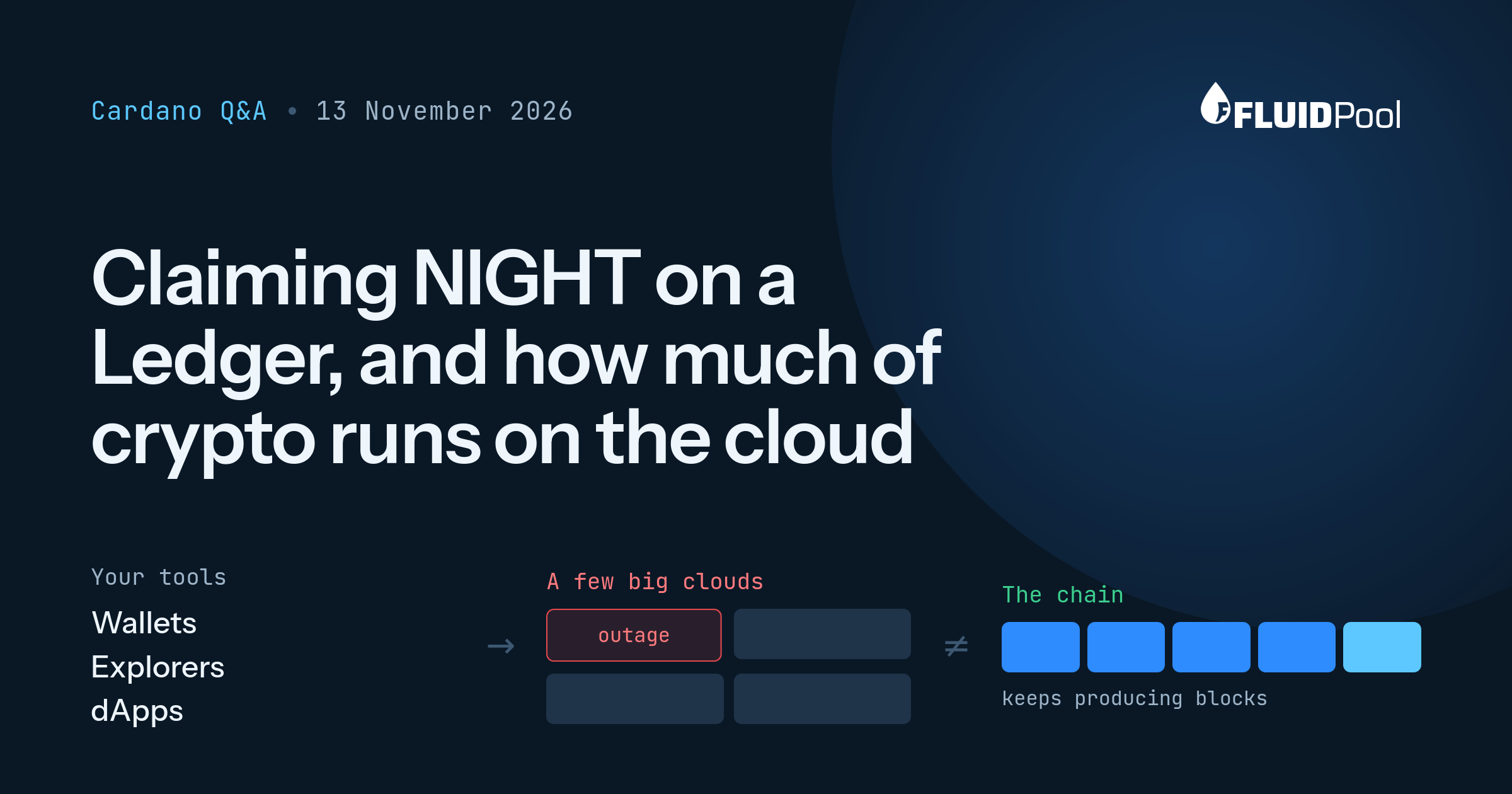
Part of the trouble connecting the Ledger may have been down to an outage at a major cloud provider. That led to a wider point. Blockchains are meant to be decentralised, but many wallets, explorers and apps run on Microsoft, Cloudflare, Google or Amazon. When one of them goes down, a lot of crypto goes with it, even though the chain itself keeps producing blocks. It is worth knowing which of the tools you rely on have a single point of failure, and keeping a fallback such as a second wallet app.
Peras and the state of Cardano
https://pool.fluid7.com/blog/ouroboros-peras-faster-settlement
We came back to Ouroboros Peras, which aims to cut the time before a Cardano transaction can be treated as settled to about two minutes. Some fast-finality chains get their speed from a voting design that halts or needs manual intervention when voting breaks down. Peras keeps today's Praos consensus underneath as a fallback, so the chain keeps accepting transactions and simply loses the speed-up until voting recovers. Our full explainer is linked above.
That stability and security record is one of Cardano's strongest cards with institutions. The harder part is the economics: a lower ADA price shrinks the value of developer funding, and transaction volumes are still low. The view on the call was that the ecosystem needs both more on-chain activity and more outside investment for that to change.
Also discussed
Developer funding and transaction volume, Cardano's appeal to institutions, and early ideas for insuring crypto wallets against hacks.
Join the next call
We run the Cardano Q&A live every Friday morning: https://fluid7.com/cardanoqa