 Cardano SPO
23 October 2026 · Cardano Q&A
Cardano Q&A recap, 23rd October 2026
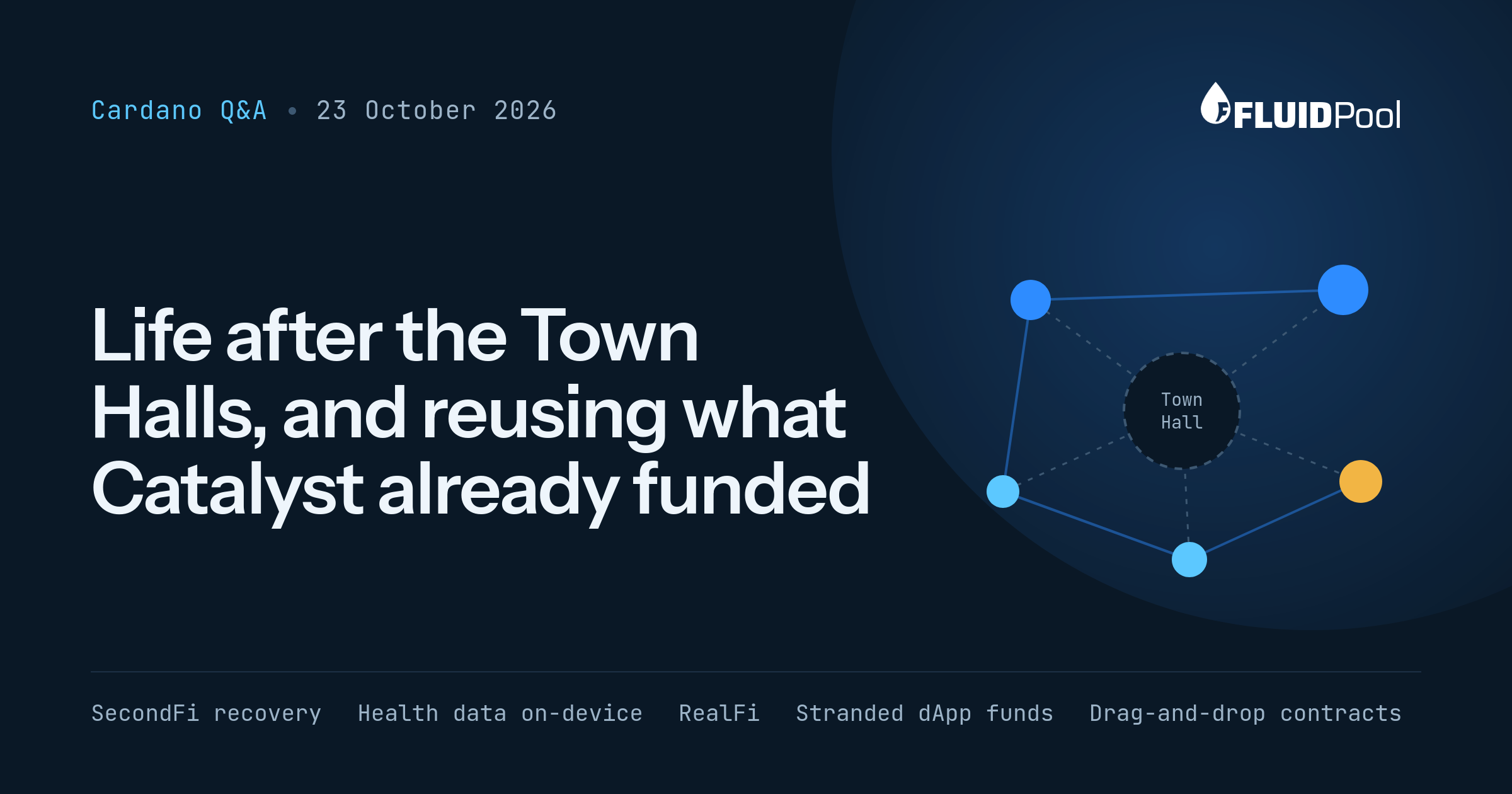
Friday's Cardano Q&A wandered a long way from the agenda, which is always a good sign. We talked about where the community gathers now that the Catalyst Town Halls have long gone, what wallet users can learn from the SecondFi incident, why health data belongs with the person it describes, and how much good work Catalyst has already paid for that nobody is reusing. Here is the rundown.
Life after the Catalyst Town Halls
The weekly Town Halls were where a lot of Cardano people met each other, and their loss has left a gap. The ecosystem is splitting into smaller, independent groups and companies, with IOG itself breaking into separate entities, and coordination now depends on grassroots hubs rather than one central call. We floated the idea of a self-funded community summit for people already building here, somewhere cheaper than the usual conference cities, and talked about why in-person meetups still matter when so much happens online.
SecondFi Recovery - recovering eligible assets after the SecondFi security incident
The SecondFi recovery process for affected Yoroi users came up, along with the bigger question it raises: who looks after a wallet's security once a community depends on it. We talked about a community-owned, open-source wallet, built as a solid core with approved community plugins on top, so features like richer NFT display can be added without touching the part that guards your keys. If you were affected by the compromise, the recovery site explains who is eligible and how to claim.
RinoMONITOR - posture and breathing monitoring that keeps data on the device
https://www.rinoestoma.com/rinomonitor
RinoMONITOR watches posture and breathing through a laptop or phone camera. Its site says it processes video locally and keeps patient data encrypted on the device. That led to a wider point about health data sovereignty. Native apps can keep data on your own device, where web apps usually send it to someone else's server. Midnight, with its focus on privacy, could act as a private store for health and biometric records that only the owner can unlock.
RealFi - a stablecoin backed by real-world assets
RealFi hit mainnet this month. It is the platform behind USDrf and sUSDrf, stablecoins backed by real-world assets. We compared how traditional finance and DeFi handle time: smart contracts let assets move instantly, while anything with people and real-world lending behind it tends to run on fixed cycles and lock-in periods. Check RealFi's own pages for current terms and eligibility.
Recovering funds from retired dApps
https://x.com/LarsBrunjes/status/2113027332860792873?s=20
When a dApp shuts down, the funds in its smart contracts don't vanish, but without a working front end most people can't reach them. We talked about the open-source work that kept Genius Yield's contracts reachable after the project wound down, and the case for a general-purpose UTXO recovery tool, so retired projects stop stranding their users' funds.
Drag-and-drop smart contracts
https://playground.marlowe-lang.org/#/blockly
Building on Cardano still needs a lot of specialist knowledge. One idea was a composable interface, in the spirit of Blockly used by Marlowe, where tested contract pieces snap together like a jigsaw. Getting there needs a map of the components and contract templates that already exist, and of how the builder tools depend on each other.
Reusing what Catalyst has already funded
Catalyst has funded hundreds of projects, and much of that code and thinking is sitting unused because teams moved on or never found a market. A proper map of funded projects, and what each one actually delivered, would let new builders pick up where others stopped instead of starting from scratch. AI tools make that kind of revival much cheaper than it used to be.
learn.45b.io - five funded Web3 cohorts, what they ran and published
45B's learning platform hosts processed recordings of its training calls, with subtitles and summaries, so you can work through the material directly instead of hunting through a video platform. It fits a wider shift: AI is changing how people find and consume content, and creators can reach learners without a platform in between.
Gimbalabs - open spaces to learn and collaborate
Gimbalabs has long been one of the community's open learning spaces for Cardano developers, and it came up as we discussed tools for community coordination.
Join the next call
We run the Cardano Q&A live every Friday morning: https://fluid7.com/cardanoqa