 Cardano SPO
16 October 2026 · Cardano Q&A, Bitcoin DeFi
Bitcoin DeFi on Cardano: the hype, the roadmap, and what is actually live
There is more idle Bitcoin in the world than almost any other pool of capital on earth. Cardano wants to put it to work. The question worth asking before you get excited is a simple one: how much of this can you actually use today?
Bitcoin is the largest asset in crypto and, for the most part, it just sits there. It earns nothing. For years the pitch of "Bitcoin DeFi" has been to change that: let people keep their BTC and still borrow against it, lend it, or earn a yield on it. Ethereum went down this road first, mostly by wrapping Bitcoin into a token that a custodian holds for you. Cardano's bet is that it can do the same job without asking you to hand your coins to anyone.
That is the promise. Charles Hoskinson has spent the last two years describing Cardano as the place where idle Bitcoin becomes productive capital, with developers building hybrid apps and users paying fees in BTC rather than ADA. It is a genuinely good story, and parts of it are already real. But a fair amount of it is also still a story, so it is worth separating what has shipped from what has merely been announced - the gap between the two is the whole point.
What is actually live
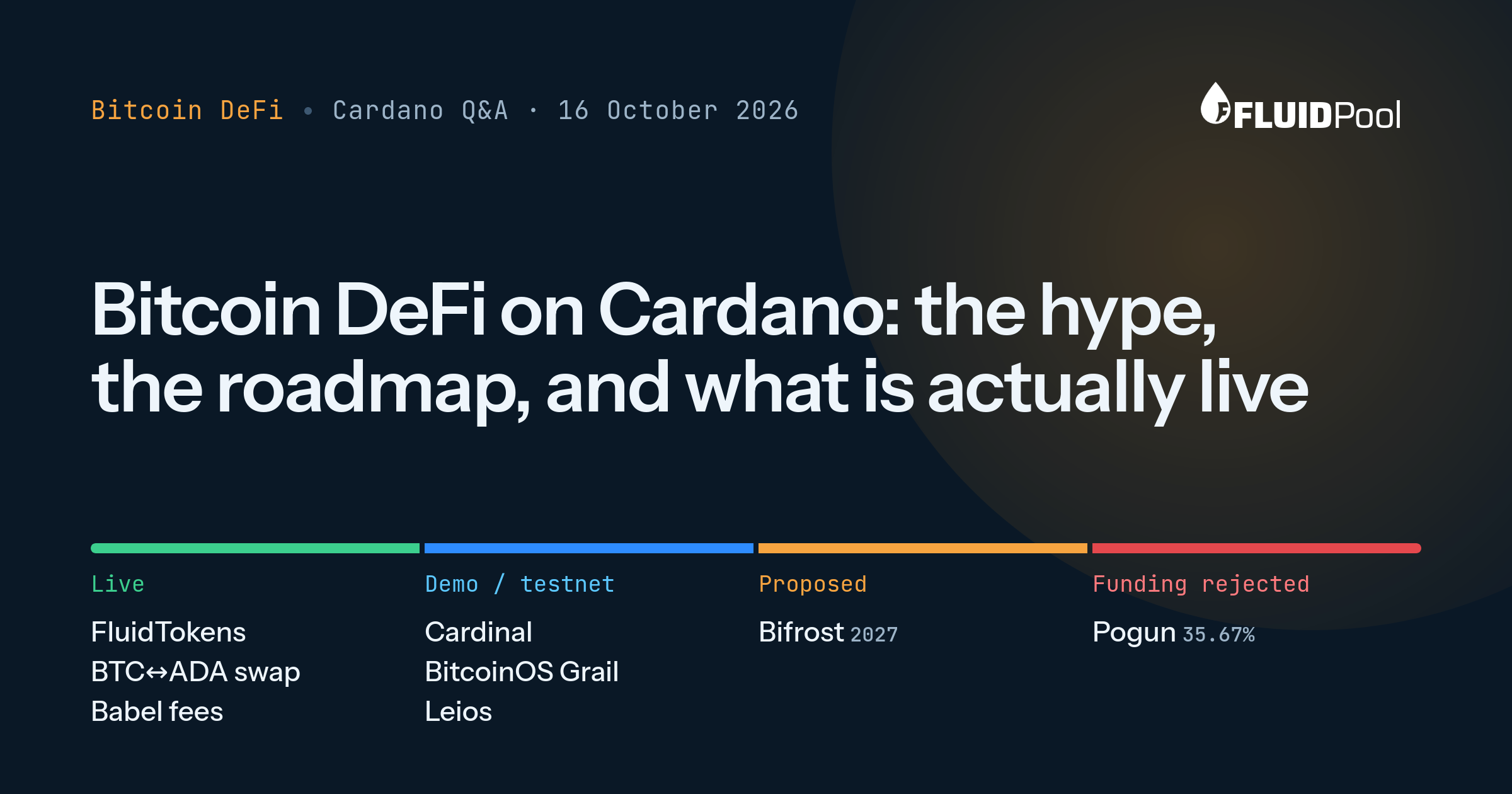
Start with the part the sceptical headlines miss. FluidTokens, a Cardano-native team, already runs a suite of live, non-custodial Bitcoin DeFi products (Live): borrowing and lending against Bitcoin-native assets like Ordinals and Runes, staking of Runes, Ordinals and Alkanes (with BTC itself flagged as coming soon), and the first decentralised exchange for Runes. These run as Bitcoin Layer 1 scripts through the team's BitWeave technology, with no custodian and no separate layer-two - you lock your assets on-chain and keep control throughout, and FluidTokens says the protocols are audited by third parties. So Bitcoin DeFi coming out of the Cardano world is not hypothetical; it has been operating for a while.
One honest caveat about the title, though. Much of that activity settles on Bitcoin's own base layer rather than on the Cardano chain, so it is better described as Bitcoin DeFi built by a Cardano team than as Bitcoin value doing DeFi on Cardano. The piece that genuinely crosses the two chains arrived in March 2026, when FluidTokens executed the first native Bitcoin-to-ADA atomic swap - 0.0001 BTC for 50 ADA, with no bridge, no wrapped token, and no custodian in the middle. That matters because it proves the hard part is possible: moving value between the chains without trusting anyone to hold the coins.
Be honest about scale, too. The swap was a fraction of a single Bitcoin and a demonstration rather than an open service, and on the Cardano chain specifically there is not yet a BTC-backed DeFi product with large sums flowing through it. Public TVL figures for "Cardano BTCfi" do not really exist, and the fees on FluidTokens' live Bitcoin products are modest (DefiLlama puts them in the low hundreds of dollars over a recent month). The capability is real; the volume is early.
The bridges, and why they are the whole game
Everything else is about one question: how do you get Bitcoin onto Cardano so it can do something? Several teams are building answers, and they are at very different stages.
Cardinal, from IOG, wraps Bitcoin into a Cardano-side asset while keeping you as a required co-signer, so no operator can move your coins alone. It was demonstrated at the Bitcoin 2025 conference in Las Vegas and a "1.0" has been promised, but it remains a demo (Demo) rather than a production release. BitcoinOS and its Grail bridge take a different route, using zero-knowledge proofs instead of a custodian, and have shown Bitcoin making the round trip to Cardano and back (Demo). Both projects make strong claims about being trust-minimised; both of those claims are, so far, the projects' own and have not been independently audited.
Then there is Bifrost, which is interesting for this audience because it would be secured by stake pool operators holding the bridge's keys. It is a proposal (Proposed), funded through the treasury, and its own plan defers a public launch to a second phase in 2027, once the bridge has been proven on-chain. In other words, the people building it are telling you not to expect it this year.
The common thread among the bridges is the promise of self-custody instead of a custodian. It is the right ambition. For these cross-chain routes specifically it is still largely unproven in production, and Cardano is not first to try it.
The flagship that governance turned down
IOG's headline Bitcoin DeFi product is Pogun (Funding rejected), a lending and yield platform it pitched with an ambitious schedule: a credit market, a yield app, and a trust-minimised bridge across 2026. But Pogun needed treasury money to be built, and in the on-chain vote that closed on 24 May 2026 the DReps said no. It drew only 35.67% of DRep stake in favour (64.33% against) where the new governance needs 67%, and IOG said the team is now reworking it in light of the community's feedback. So the flagship is not a product that has quietly slipped its dates; it is a proposal the chain's own voters declined to fund.
That is not the end of the story, though. The team has kept building, and in August 2026 it published a mainnet prototype of Pogun's "Mirror" collateral system - two real Bitcoin transactions, recorded on 4 August, showing the dispute mechanism in action: one honest committee member blocking a fraudulent withdrawal, and a genuine challenged withdrawal completing. It is explicitly prototype evidence rather than a finished product - the site still says Bitcoin collateral is not live and the market is "coming soon" - but it is a concrete demonstration that the trust-minimised design does what it claims, funded or not.
The part worth dwelling on is what the rejection actually bought. Pogun's proposal was not a grant request - it offered the Cardano Treasury a return: 20% of the project's EBITDA until the ₳12.29M (about $2.95M) was repaid, then a 5% share in perpetuity. Voting no kept that 12.29M ADA in the treasury, but it also forfeited that revenue share. Meanwhile the team has kept developing Pogun - the August mainnet prototype is the evidence - and on his 18 September 2026 broadcast Hoskinson said IOG would build each product on whichever network serves it best rather than defaulting to Cardano, giving Pogun a target of roughly 90 days out (about mid-December). Coverage differs on whether Pogun still lands on Cardano, but the direction of travel is plain: a product the chain could have held a perpetual stake in is proceeding on its own terms, and may not run on Cardano at all. There is a prudent-stewardship case for the no vote, but for a chain that says it wants to own its future, forfeiting a perpetual share of a product its own core developer is still shipping looks short-sighted.
Paying fees in Bitcoin, and making room to scale
Two supporting pieces make the vision coherent, and here the picture is better than the headlines suggest. The first is Babel fees (Live, small), the idea that you could pay a transaction fee in something other than ADA. This part is real today: FluidTokens' Aquarium protocol on Cardano lets you pay a fee in a custom native token rather than ADA, and has done since 2025. The catch for the "spend only Bitcoin" version of the pitch is that paying specifically in BTC first needs Bitcoin to exist as a Cardano-side asset, which loops straight back to the bridges that are not finished yet. A deeper, protocol-native version of token fees - the CIP-159 account-address work inside IOG's funded Cardano Upgrades - is also still being built. So the mechanism is live; paying your fee in actual BTC is the piece still gated on bridging. The second piece is Leios (Testnet), the throughput upgrade behind Cardano's long-term scaling pitch, in testnet through 2026 with a mainnet candidate aimed at year end - IOG framed success as finishing the engineering, not landing the upgrade this cycle. Leios is not a Bitcoin feature, but without it the grander DeFi numbers do not add up.
Money and governance
All of this runs on treasury funding now decided on-chain by the community rather than by a foundation, and the 2026 vote shows what that means in practice. IOG put up a slate of proposals worth roughly $46.8 million, about half the previous year's ask, and when voting closed on 24 May 2026 the results split sharply along a telling line. The infrastructure passed comfortably: the Leios scaling initiative cleared with about 84% approval and 27.7 million ADA, and the Cardano Upgrades work that carries Babel fees passed too. The Bitcoin DeFi flagship did not - Pogun was rejected with 35.67% in favour, alongside a layer-two scaling proposal, a Blockfrost indexing request, and IOG's own research proposal. For good measure, the 2026 Cardano Summit was cancelled after its funding failed to clear the bar. The read is worth sitting with: the voters funded the plumbing and declined the headline product. Every proposal and its DRep tally is on-chain - the links above go to the threads on DRepTalk, and its epoch 633-635 governance review collects the whole budget vote in one place.
How to read the hype
If you take one thing from this, let it be the vocabulary. "Live on mainnet," "testnet," "announced," and "proposed" are four very different things, and the marketing around Bitcoin DeFi blurs them constantly. On that scale, the Cardano world today has live but modest Bitcoin DeFi from FluidTokens (lending, staking, a Runes DEX, mostly on Bitcoin's own layer), one small cross-chain atomic swap, a working Babel fees implementation, a couple of genuine bridge demos, funded scaling infrastructure still being built, and a flagship Bitcoin-backed credit product (Pogun) whose funding its own governance declined, even as the team shipped a mainnet prototype of it.
That is not a criticism so much as a reality check. The engineering on display - keeping Bitcoin self-custodial while making it useful - is genuinely hard and genuinely interesting, and a trust-minimised route beats a custodial one if it ships. But Cardano is not first here; others have already put trust-minimised Bitcoin bridges on mainnet, so the competition is on execution, on the net yield after fees, and on exactly whose keys you are really trusting. Those are the questions worth asking of any BTCfi project, Cardano's included.
FAQ
Can I use my Bitcoin in Cardano DeFi today? Not in any meaningful public product on the Cardano chain itself. FluidTokens runs live, non-custodial Bitcoin lending, staking and a Runes DEX, but mostly on Bitcoin's own layer. The clearest cross-chain proof is FluidTokens' tiny March 2026 BTC-to-ADA atomic swap, which was a proof of concept rather than an open service.
Is this custodial like wrapped Bitcoin on Ethereum? The intent is the opposite - self-custody via co-signing, zero-knowledge proofs, or pool-held thresholds instead of a single custodian. But most of the cross-chain work is still demo or proposal, and those trust-minimisation claims are largely unaudited.
Can I pay Cardano fees in a token instead of ADA? Yes, today. FluidTokens' Aquarium protocol lets you pay a Cardano transaction fee in a custom native token rather than ADA, and has since 2025. Paying specifically in BTC is the harder step, because it first needs Bitcoin represented as a Cardano-side asset, which depends on the bridges still being built. A protocol-native version of token fees (CIP-159) is funded and in progress.
So is Bitcoin DeFi on Cardano live, or a roadmap? Mostly a roadmap, but with real proof points. Live today: FluidTokens' Bitcoin DeFi, a small atomic swap and a working Babel fees implementation. Demos: Cardinal and BitcoinOS. Funded and building: Leios and the native Babel work. Declined or deferred: Pogun's funding was rejected in May 2026 (though the team shipped a mainnet prototype in August), and Bifrost's own plan pushes a public launch to 2027.
A note on sourcing. The governance outcomes here are on-chain and verifiable via DRepTalk, gov.tools, cexplorer or adastat; project status is drawn from the teams' own docs and announcements (FluidTokens' Aquarium platform, pogun.io, IOG's momentum and labs sites). DeFi usage moves quickly, so DefiLlama's FluidTokens and Cardano pages are the live reference for TVL and fees. Figures here are current to roughly mid-2026; where something is proposed rather than shipped, that is the known position as of writing.